What Muscle Does as It Heats
The changes inside a chicken's muscle are not gradual. They happen in stages, at specific temperatures, and the whole of cooking a bird is managing the sequence.
The proteins that firm first
Raw chicken muscle is mostly water held in a meshwork of proteins. Heat that meshwork and the proteins begin to denature — to unfold and then bond with neighbouring proteins — changing the texture from yielding to firm. The first proteins to go are the myosin chains, which start to denature somewhere around 50 °C (122 °F). At that point the meat begins to firm noticeably; the translucent pink starts to fade. It is still, by any conventional food-safety standard, undercooked, but the structural change has already begun.
By around 60–65 °C (140–149 °F), the bulk of the actin proteins follow. Actin is less forgiving than myosin: once it denatures it contracts hard, squeezing the cells and forcing moisture out. This is why a breast taken to 74 °C (165 °F) — the standard USDA safe temperature for poultry — can feel dry. The myosin had already firmed and the actin then wrung the muscle out. The window between the two events is the temperature range every serious cook is trying to stay inside, or exit as briefly as possible.
Collagen is the complication
Connective tissue introduces a third event, and it runs in the opposite direction. Collagen — the tough protein sheeting that wraps muscle fibres and binds them to bone — does not firm and release water as temperature rises. Given enough time and enough heat, above roughly 70–75 °C (158–167 °F), it converts to gelatine. The solid sheath dissolves into a slippery, lubricating gel that makes tough cuts feel tender and gives braising liquids their body.
This is why the breast and thigh want opposite treatment. The breast is a large, low-collagen muscle that sits on a bird doing almost nothing; heat it hard and you dehydrate it before collagen softens anything. The thigh is a smaller, higher-collagen muscle constantly worked; it needs to pass through the actin contraction and keep going, long enough for the collagen to yield. Undercooking a thigh leaves it rubbery. Overcooking a breast leaves it chalky. The biology is the same bird; the target temperatures are not.
Collagen — the tough protein sheeting that wraps muscle fibres and binds them to bone — does not firm and release water as temperature rises.
What this means for timing
The denaturation events themselves are largely irreversible. Once actin has contracted and pressed water from the fibres, no amount of resting or sauce will rehydrate the meat. What you can do is stop short of the most damaging event by pulling the breast earlier, or carry a thigh well past it while the collagen conversion compensates for the moisture lost. Both approaches acknowledge the same underlying biochemistry — they just work with different parts of the sequence.
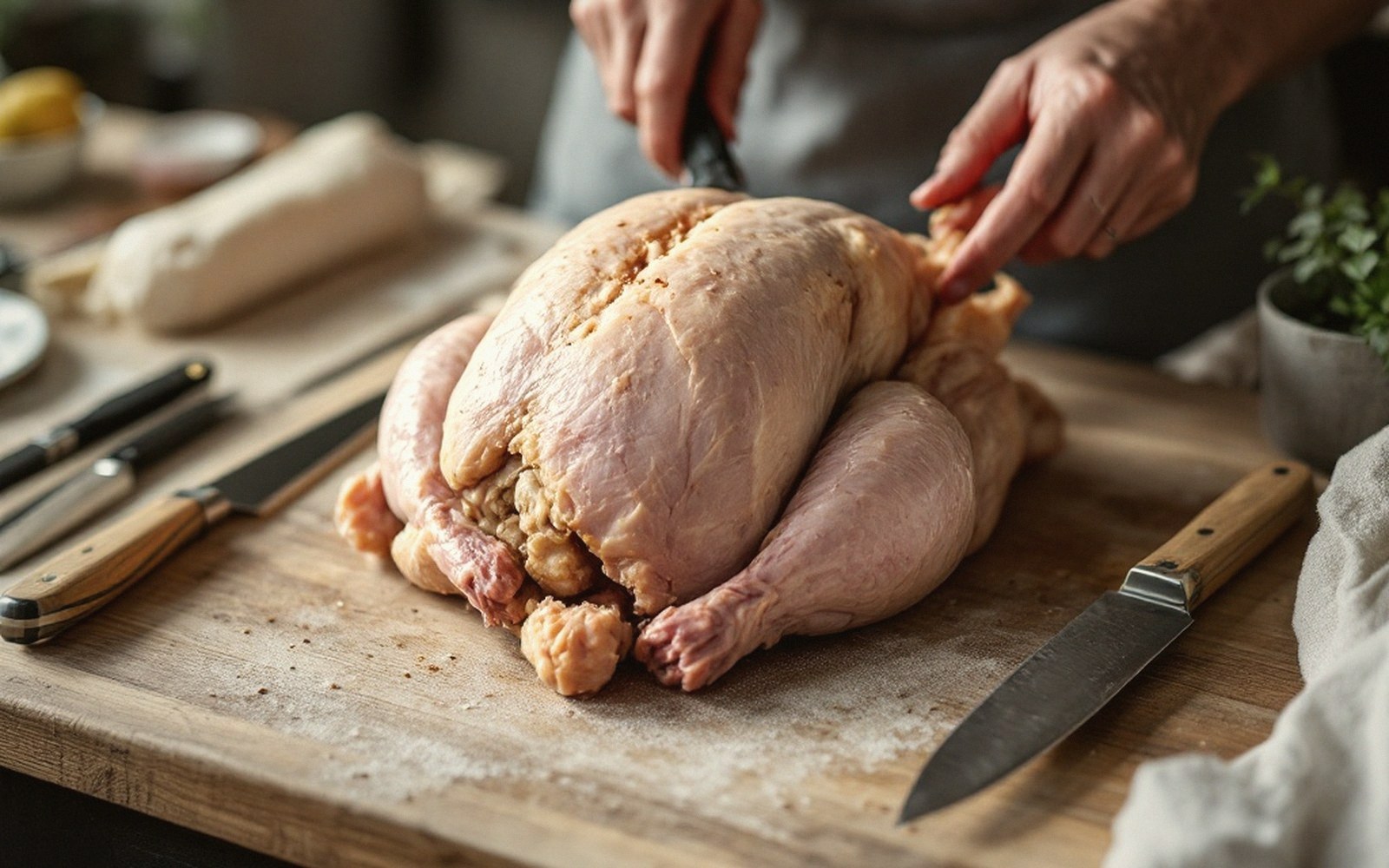
Carryover matters here too. A muscle removed from the oven is not finished cooking. Retained heat continues to denature proteins after the bird leaves the pan, which is why a breast pulled at 65 °C (149 °F) will rise several degrees before it plateaus. Where to put the probe and how to read the climb is a separate matter, but the temperature you remove the bird at and the temperature it reaches are not the same number. Building in that margin is the practical expression of understanding the sequence.
The whole point
Cooking a chicken is not, at its core, about following instructions. It is about steering three overlapping protein events: myosin firming early, actin firming and squeezing hard through the middle range, and collagen softening late for those cuts that have it. Every technique — braise, roast, poach, confit — is a different way of handling the same underlying chemistry. The temperature you choose, the time you allow, the cut you select: all of it is a decision about where in that sequence you want to intervene, and which event you are trying to promote or avoid.
A Chicken in the Kitchen is an independent guide to cooking. It is not a restaurant, retailer or nutrition service.